News and Analysis
October 22, 2026


If you have ever spent time on Kenyan roads, the bright red "L" sticker on some cars is a familiar sight. For some motorists, it is a sign to keep a respectful distance, while for others, it is a reminder of their own early days behind the wheel.
However, beyond being a newbie badge, the Learner (L) sticker is a legal requirement governed by the Traffic Act of Kenya.
Here’s what every Kenyan driver needs to know about the law that governs the use of the “L” sticker.
Under the Traffic Act, any driver holding a provisional licence is required to display a learner’s sticker prominently on both the front and rear of the vehicle.
This is meant to signal to other road users that the driver is still learning and may require extra caution.
Driving without this sticker is classified as a traffic offence, and offenders can face a fine of Ksh1,000. It’s important to note that the law applies strictly to learner drivers.
Also Read: How to Transition From Red Driving License to NTSA's Smart Driving License and Charges Involved
A provisional licence comes with specific conditions designed to protect both the learner and other road users. According to the regulations:
The learner must always be accompanied by a qualified driver sitting next to them. This person must hold a valid driving licence for the class of vehicle being driven.
This rule does not apply to motorcycles ridden on two wheels without a sidecar. It also does not apply to vehicles designed without a passenger seat next to the driver.
The learner must exhibit a clearly visible “L” sticker on the front and back of the vehicle. The sticker should be visible to everyone in front of or behind the car. Most Kenyans prefer to have the sticker on the windscreen and the rear glass.
Any driver with a provisional licence is not allowed to operate as taxis.
“The holder of the provisional licence shall not carry any passenger on a motorcycle that is carried on two wheels without a sidecar attached or drive any motor vehicle that is carrying passengers for hire or reward,” reads the law in part.
Also Read: Process of Transferring Vehicle on NTSA Portal and Charges Involved
Before being granted the licence, applicants must meet certain health and physical fitness standards to ensure road safety. The learners must certify that they do not suffer from conditions such as epilepsy, sudden attacks of disabling giddiness, or fainting, which could compromise their ability to operate a vehicle safely.
Applicants are also required to demonstrate sufficient visual acuity, being able to read a motor vehicle number plate at a distance of 25 metres in good daylight (with glasses if necessary).
Additionally, they must be free from any physical disability affecting movement, muscular control, or strength in the arms or legs, and must not have any other mental or physical conditions that could make driving a danger to themselves or the public
Also Read: How to Check If NTSA Has Processed Your DL or Number Plate on the New Portal
A provisional licence is typically valid for three months, during which the learner must adhere to the above rules. Within this period, learners are expected to practice under supervision and develop safe driving habits.
Obtaining a provisional license costs Ksh600.
According to the traffic rules revised and gazetted in 2016, the standard fine for driving without a learner’s sticker in Kenya is Ksh1,000.
The Traffic Act does not explicitly ban experienced drivers from using vehicles that have the sticker; however, various motorists have shared having issues with police when they produced their driving licence to the cops.
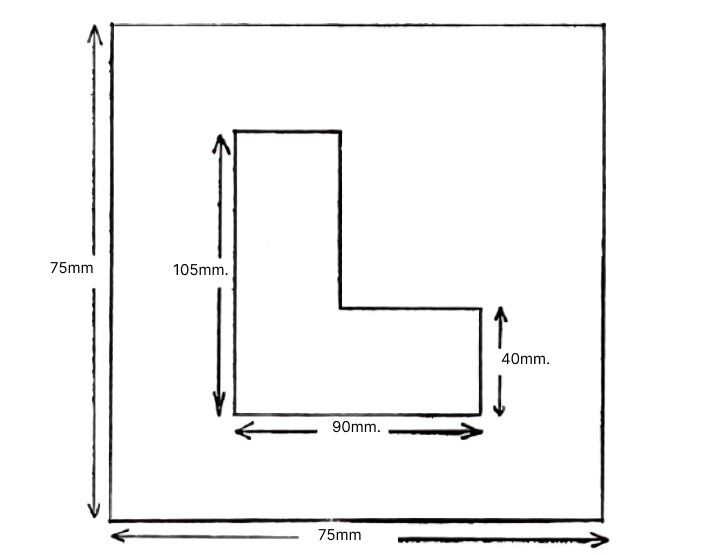
The Traffic Act also stipulates the size of the sticker. In particular, the “L” must be on a white background that is square in shape. The sides of the square must measure 75 millimeters or 7.5 centimeters.
.png)


Join 1.5M Kenyans using Money254 to find better loans, savings accounts, and money tips today.


Money 254 is a new platform focused on helping you make more out of the money you have. We've created a simple, fast and secure way to find and compare financial products that best match your needs. All of the information shown is from products available at established financial institutions that our team of experts has tirelessly collected.