News and Analysis
October 5, 2026


Welcome to the Money News Roundup. Today, we cover the planned extension of the SGR from the Syokimau terminus to Nairobi CBD. We also look at the CMA's warning to special fund managers.
Kenya Railways is set to extend the Standard Gauge Railway (SGR) into Nairobi CBD, ending the last-mile challenge that has forced passengers to travel between the city centre and the Syokimau terminus.
The planned 15-kilometre extension will enable passengers to board SGR trains directly from Nairobi CBD instead of connecting via the ageing metre-gauge railway, matatus, or taxis.
As reported by the Business Daily, the 15-kilometre extension will follow the existing metre-gauge railway corridor from Syokimau through Embakasi, Imara Daima, Donholm and Makadara before terminating at Nairobi Central Station.
However, the new SGR service will only have passenger stations at Imara Daima, Makadara and Nairobi CBD.
The project will also upgrade a flood-prone section of the metre-gauge line, construct a bridge over the Mukuru River and rebuild the Likoni bridge to improve reliability.
While the cost of the extension is not known, the project is expected to form part of the Ksh28 billion Nairobi Railway City project.
Commuters were stranded on Tuesday morning after police mounted roadblocks on major roads leading to Nairobi CBD ahead of the Saba Saba protests.
As reported by the Star, some of the affected roads included Waiyaki Way near Kinoo, Lang'ata Road, Mombasa Road, Jogoo Road, Kiambu Road, and Thika Road.
Motorists reported that police were allowing private vehicles to proceed after conducting inspections, while matatus were turned away at the roadblocks, leaving many Kenyans who were headed to work stranded.
The security checks also triggered heavy traffic snarl-ups on several major highways leading into the city.
On Monday night, the National Police Service announced that it would set up roadblocks and intensify security checks to regulate the movement of vehicles and individuals entering the CBD ahead of the planned Saba Saba demonstrations.
The Capital Markets Authority (CMA) has warned managers of special funds against misleading marketing practices, including promoting high returns without adequately disclosing the associated risks.
As reported by the Business Daily, the regulator raised the concerns during a meeting with fund managers on July 2, citing unethical advertising, poor disclosures and the use of unqualified sales representatives, including social media influencers.
Special funds held Ksh203.5 billion in assets as of March 2026, accounting for 23.9% of the collective investment schemes market. Unlike money market funds, they invest across higher-risk assets such as equities, private equity, real estate and offshore investments.
The CMA is also considering tighter regulations amid concerns about fraud, inconsistent reporting of returns and the possibility that some managers may be masking investment losses with fresh investor inflows.
Meanwhile, as reported by Kenyan Wall Street, CMA has granted licences to ADAR Asset Management, Entrust Advisory and Everstrong Asset Management, which will manage collective investment schemes across asset classes, including private equity, infrastructure and real estate.
The government has allayed fears over plans to use SACCO members' savings to finance the National Infrastructure Fund (NIF), insisting deposits remain under the control of individual cooperatives.
As reported by the People Daily, Principal Secretary Patrick Kilemi said SACCO funds belong to members and are managed independently by elected officials, with no government access.
The clarification follows concerns over reports suggesting more than Ksh1 trillion in SACCO deposits could finance infrastructure projects.
Nonetheless, the Sacco Amendment Bill of 2025, if passed, will allow secondary SACCOs, formed by multiple SACCOs, to invest in government securities and bonds.
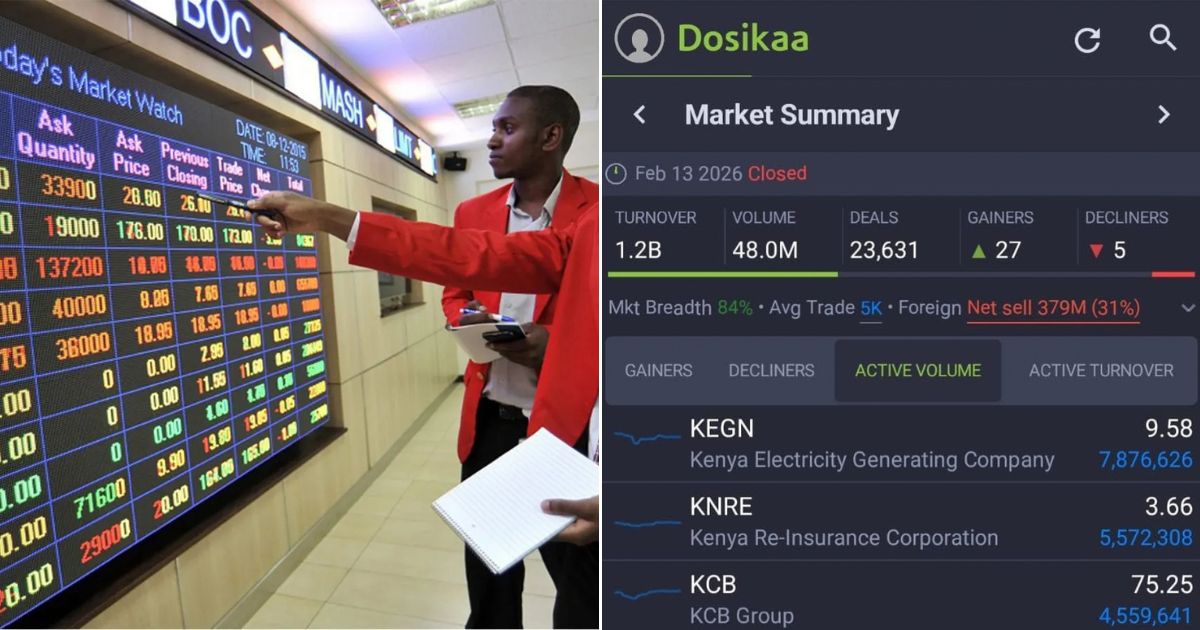
Foreign investors in Kenya's blue-chip stocks earned an 18.8% dollar return in the first half of 2026, supported by a stable shilling that limited currency losses. According to Morgan Stanley Capital International (MSCI) data, gains were driven by strong performance in Safaricom and major banking stocks.
In local currency terms, the Nairobi Securities Exchange (NSE) gained 27.8%, lifting market capitalisation to a record Ksh3.76 trillion. However, the increase was partly boosted by the listings of Kenya Pipeline Company and Family Bank.
Nigeria and Zimbabwe posted Africa's strongest dollar returns, while Kenya ranked behind Tunisia, South Africa and Côte d'Ivoire during the period. Read more
Varun Beverages, PepsiCo's largest bottling franchise outside the US, will acquire the dairy beverages, juices and packaged water business of Daima owner Devyani Food Industries (Kenya) for Ksh4.15 billion.
As reported by Khusoko, the deal gives Varun control of Daima's 52-acre manufacturing plant in Nakuru and marks its entry into East Africa's dairy market. The acquisition is expected to be completed by August 1, 2026.
Varun said the facility will strengthen its regional expansion plans and support the future launch of carbonated soft drinks alongside its existing dairy, juice and water operations.
.png)


Join 1.5M Kenyans using Money254 to find better loans, savings accounts, and money tips today.


Money 254 is a new platform focused on helping you make more out of the money you have. We've created a simple, fast and secure way to find and compare financial products that best match your needs. All of the information shown is from products available at established financial institutions that our team of experts has tirelessly collected.






![CBK Approves 29 New Digital Lenders [LIST]](https://cdn.prod.website-files.com/6038c1030be2580db46ccf46/6abce37f51393f90d11dbea6_top%20image%20%2B%20Templates%20%20-%202026-09-30T132202.886.jpg)





![You Have Ksh7 Million: Buy a Home in Cash or Rent and Invest? [The 10-Year Numbers]](https://cdn.prod.website-files.com/6038c1030be2580db46ccf46/6abbbdaf2080b24be31d8e0b_top%20image%20%2B%20Templates%20%20-%202026-09-29T162813.614.jpg)