News and Analysis
September 23, 2026


Hello and welcome to the Money News Roundup Newsletter, where we break down Kenya’s Ksh12.5 billion railway deal with France that will link Nairobi to five satellite towns. We also look at why billionaire Aliko Dangote is now leaning toward Kenya for his proposed East African oil refinery project.
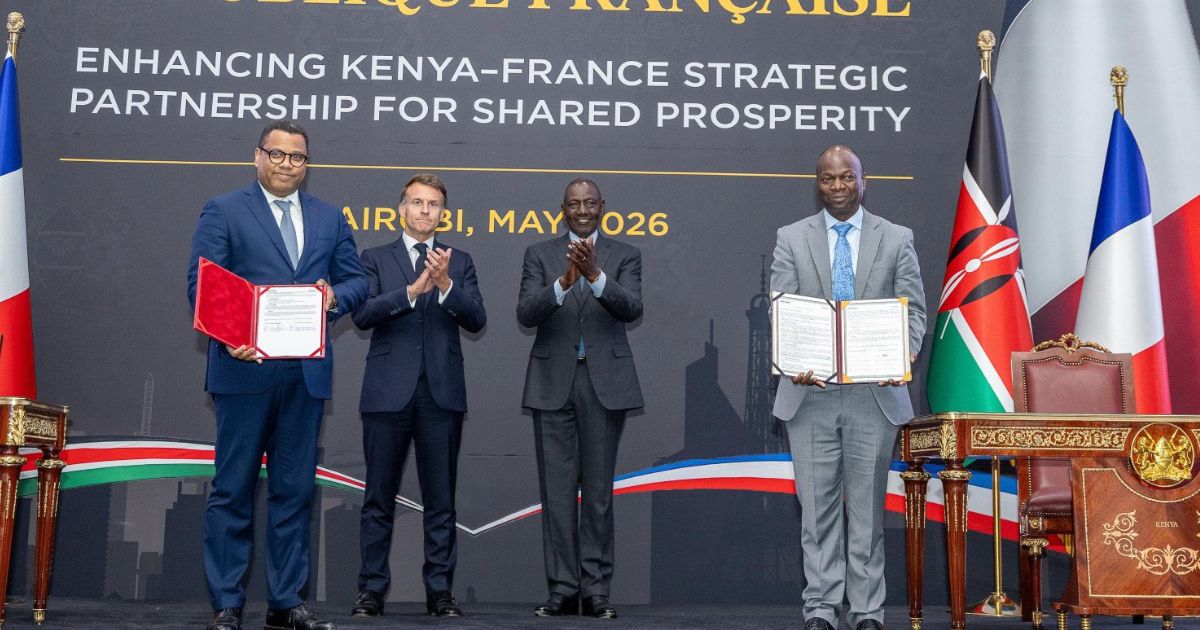
Kenya and France have signed a Ksh12.5 billion agreement to rehabilitate and modernise the Nairobi Commuter Rail network.
President William Ruto and French President Emmanuel Macron unveiled the project after bilateral talks at State House, describing it as a key pillar of Nairobi’s urban transport modernisation plan.
As reported by the Star, the project will expand and upgrade rail corridors linking Nairobi to satellite towns including Syokimau, Embakasi, Ruiru, Kikuyu, and the ongoing Riruta-Ngong line.
“We are signing off so that we can modernise our commuter rail system, especially line 5, expanding it so that it can go to Embakasi and into Ruiru. We are also working with the UK so that we can modernise Nairobi Railway City.
“Once this program is complete, with the line going up to Thika, we should be able to evacuate up to 30,000 people per hour,” Prime Cabinet Secretary Musalia Mudavadi stated.
The two countries also signed 10 other agreements covering energy, logistics, digital technology, health, education, agriculture, and climate services.
Among the major deals announced was a Ksh104 billion logistics and port infrastructure partnership and a Ksh32.5 billion expansion of the Kipeto wind power project by 100 megawatts.
Kenya and France further agreed to collaborate on cybersecurity, artificial intelligence, digital public services, and Sustainable Aviation Fuel production.
Ruto also confirmed that the Ksh5.6 billion University of Nairobi Engineering and Science Complex project had entered the implementation phase.
The National Assembly has invited members of the public and stakeholders to submit their views on the proposed Finance Bill 2026.
Kenyans and institutions can submit written memoranda physically at Parliament Buildings in Nairobi or electronically through cna@parliament.go.ke and financecommittee@parliament.go.ke before May 25 at 5 pm.
As reported by Kenyans.co.ke, among the notable proposals in the Finance Bill 2026 is a planned 25 per cent excise duty on mobile phones, a move likely to increase smartphone prices and the cost of digital access.
The bill also proposes new tax measures on mitumba imports, changes to digital platform taxation, reduced tax filing timelines from June 30 to April 30, and tighter regulation of virtual assets and cryptocurrency-related services.
Also Read: How Finance Bill 2026’s Tax Proposals Will Affect Your Money
Nigerian billionaire Aliko Dangote has said he is leaning toward Mombasa as the location for a proposed 650,000-barrel-per-day East African oil refinery, weeks after the project was initially announced for Tanga, Tanzania.
Speaking to the Financial Times, Dangote cited Mombasa’s deeper port, larger economy, and higher fuel consumption as key advantages. He added that the final decision now rests with President William Ruto.
The refinery, estimated to cost between Ksh1.9 trillion and Ksh2.2 trillion, was first unveiled in Nairobi in April during a summit attended by Ruto and Ugandan President Yoweri Museveni.
The development comes after Tanzanian President Samia Suluhu publicly criticised the earlier Tanga announcement, saying she had not been consulted.
The proposed refinery also faces supply concerns, with current regional crude production falling far below the plant’s planned capacity.
Delays in the government’splanned sale of a 15 per cent stake in Safaricom to South Africa’s Vodacom could earn the Treasury an extra Ksh16.1 billion in dividends.
The State is expected to retain its 35 per cent shareholding in Safaricom longer as court cases challenging the Ksh244.5 billion deal continue.
Safaricom recently declared a final dividend of Ksh1.15 per share, with the government now likely to benefit from payouts initially expected to go to Vodacom.
As reported by the Business Daily, the transaction, which would reduce the State’s stake from 35 per cent to 20 per cent, has faced opposition from petitioners questioning its legality and value to Kenya.
Once completed, Vodacom will increase its ownership in Safaricom to 55 per cent.
The government plans to channel proceeds from the sale into the National Infrastructure Fund to support major projects in roads, rail, energy, and water.
Safaricom says disbursements through its Fuliza overdraft facility rose 49 per cent to Ksh1.47 trillion in the financial year ended March 2026, highlighting growing reliance on mobile credit by Kenyans.
As reported by Capital Business, the company said revenue from Fuliza increased 46 per cent to Ksh6 billion, while the number of users rose to 17.7 million.
Safaricom noted that more customers are using Fuliza to complete M-Pesa transactions when they have insufficient balances.
However, the average loan size declined to Ksh218 from Ksh241 previously, indicating rising demand for smaller and more frequent loans.
Meanwhile, M-Shwari recorded slower growth, with revenue dropping 14.1 per cent to Ksh1.9 billion.
TotalEnergies Marketing Kenya has installed 30 charging stations for electric vehicles and motorbikes as the company expands beyond fossil fuels to tap into Kenya’s growing electric mobility market.
The French oil major said it partnered with firms including Ampersand, Roam, and Arc Ride to set up 28 charging and battery-swapping stations for electric motorbikes and two charging stations for electric cars.
As reported by the Business Daily, the move comes as Kenya experiences rising adoption of electric mobility, driven by efforts to reduce carbon emissions and high fuel prices.
According to the Electric Mobility Association of Kenya, registrations of electric vehicles, motorcycles, bikes, and three-wheelers rose to 9,144 in 2024 from 4,048 the previous year.
Mastercard and Yellow Card have announced a partnership to expand stablecoin-based payment solutions across Eastern Europe, the Middle East, and Africa, including Kenya.
As reported by Capital Business, the collaboration will explore the use of stablecoins in cross-border money transfers, business-to-business payments, digital loyalty programmes, and treasury management.
The initial rollout will target Kenya, Ghana, Nigeria, South Africa, and the United Arab Emirates.
According to the two firms, the partnership aims to help banks and financial institutions develop secure and compliant blockchain-based payment systems.
Yellow Card CEO Chris Maurice said the deal would improve access to affordable cross-border payment solutions in emerging markets.
Mastercard added that the initiative will strengthen the security of digital asset payments using its Crypto Credential technology.
Delivery platform Glovo has opened new regional headquarters in Nairobi as competition in Kenya’s online delivery sector intensifies.
The company says the Nairobi office will serve as its African operations hub, alongside a planned Ksh10 billion investment in Kenya by 2030.
As reported by Citizen Digital, Glovo said the investment will support expansion into more towns outside Nairobi as firms compete for a larger share of Kenya’s digital commerce market.
According to the company, orders on its platform grew by 40 per cent last year, while businesses using the app have generated over Ksh20 billion in sales since 2019.
Trade CS Lee Kinyanjui said digital platforms are helping small businesses access wider markets and driving growth in Kenya’s ICT and hospitality sectors.
Glovo also projected quick commerce to become one of the fastest-growing areas in e-commerce over the next decade.
Listed agricultural firm Kakuzi plans to expand its blueberry farming acreage more than eightfold to 82 hectares by 2029 as it diversifies beyond traditional crops such as avocados.
Disclosures by parent company Camellia Plc show blueberry production will rise from the current 10 hectares to 22 hectares by the end of 2026 before further expansion over the following years.
As reported by the Business Daily, the project forms part of a wider investment plan expected to cost about Ksh2.64 billion over six years.
Kakuzi’s blueberry business posted its first profit since the pilot project began in 2019, earning Ksh5 million in 2025 compared to a Ksh19 million loss the previous year.
Production rose to 90 tonnes from 53 tonnes, while average selling prices increased to about Ksh1,600 per kilogramme.
The company’s overall net profit recovered to Ksh387.6 million as revenues climbed 12.1 per cent to Ksh5.37 billion.
.png)


Join 1.5M Kenyans using Money254 to find better loans, savings accounts, and money tips today.


Money 254 is a new platform focused on helping you make more out of the money you have. We've created a simple, fast and secure way to find and compare financial products that best match your needs. All of the information shown is from products available at established financial institutions that our team of experts has tirelessly collected.




.jpg)


.jpg)



%20(1).jpg)